
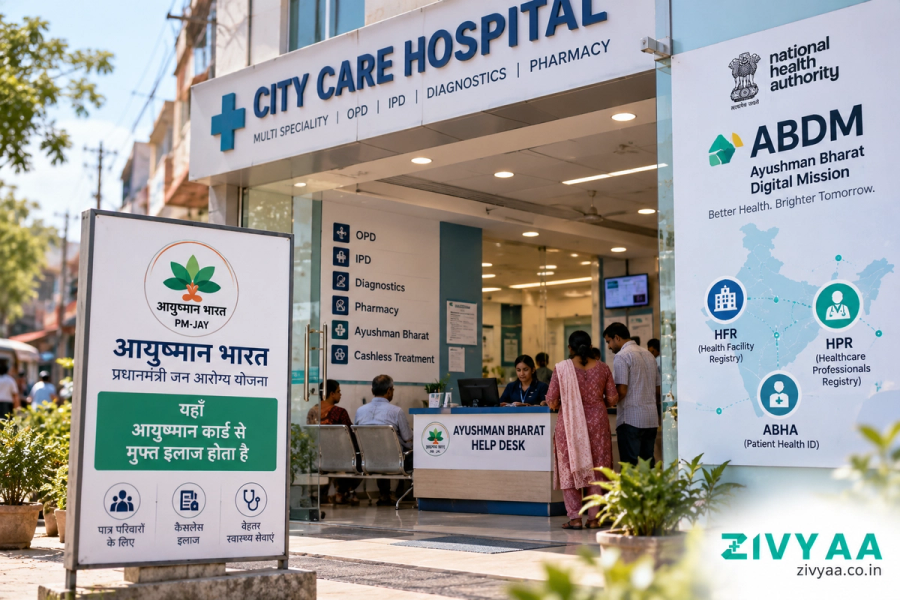
In May 2026, Uttar Pradesh stopped payments to about 100 private hospitals under Ayushman Bharat and suspended roughly 100 more from the scheme, according to reports quoting the CEO of SACHIS, the state agency that runs PM-JAY. What they had failed at was not clinical. They had not moved to the new Hospital Empanelment Module, HEM 2.0 — whose 35 standards include registration on the Health Facility Registry.
That sits oddly beside the Union Health Ministry's own line. In a December 2024 update, PIB stated plainly that ABDM is voluntary in nature. Both statements are true. They answer different questions, and a hospital owner in Gorakhpur or Basti needs to know which one applies to them.
Short answer: ABDM is voluntary across India — no national rule requires a hospital, clinic or patient to join it. But voluntary is not the same as optional in practice. According to the agency that runs the scheme in Uttar Pradesh, hospitals empanelled under PM-JAY there must now meet HEM 2.0 standards, which include HFR registration. What your scheme and your state require matters more than the national rule.
Is ABDM mandatory in India?
No. ABDM, the Ayushman Bharat Digital Mission, is the government framework for linking health records across providers with a patient's consent, and the Union Health Ministry describes it as voluntary: a PIB release of 17 December 2024 says ABDM is voluntary in nature. For patients, a PIB update of 6 February 2024 says the same of ABHA, the individual's health ID — creating one is voluntary.
Joining ABDM does not license a facility either. The National Health Authority's standard operating procedure for the Health Facility Registry says HFR is not mandated to regulate or set standards for facilities; that remains the job of laws such as the Clinical Establishments Act, 2010, and of state rules. A clinic still needs its registration under state law whether or not it ever joins ABDM.
Why are hospitals in UP being told to register on HFR?
Because a scheme can require what a law does not. PM-JAY, Ayushman Bharat's cashless cover for eligible families, is run in Uttar Pradesh by SACHIS, the State Agency for Comprehensive Health and Integrated Services. According to reports in the Free Press Journal on 15 May 2026 and Medical Buyer on 18 May 2026, SACHIS's CEO said empanelled hospitals must now fulfil 35 standards under HEM 2.0, including the hospital registration certificate, a fire safety NOC, the required infrastructure, doctors' qualifications and HFR registration.
Those reports, and Medical Dialogues on 16 May 2026, describe what happened to hospitals that had not moved to the HEM 2.0 portal: payments stopped for about 100 private hospitals, and about 100 more suspended from the scheme. For a hospital whose income depends on PM-JAY patients, that is as mandatory as anything gets.
The distinction is worth holding on to. Nobody is fining a clinic for not having an HFR ID. What is happening is that a government scheme has made its participation conditional on one — and for many private hospitals in UP, that scheme is not optional in any commercial sense.
Does a small clinic that is not on PM-JAY need ABDM?
A clinic outside PM-JAY and other government schemes is not required to join ABDM under any national rule we could find; the published national position is that ABDM is voluntary. The thing to check is your own state and any scheme you want to join, because those can add requirements the national rule does not — and a vendor's summary of a rule is not the rule.
There are still reasons a clinic might register anyway. It appears on the national facility search that patients use, its doctors can be verified on the professionals' registry, and it is ready if a scheme it wants to join starts asking. Those are choices, not obligations, and it is fair to make them on their merits.
What does ABDM compliance actually involve for a hospital?
ABDM compliance, for a hospital, comes down to three layers that are often talked about as one. The first is identity: the facility on HFR and its doctors on HPR. The second is the patient's ID: creating or linking an ABHA at registration, for patients who want one. The third is exchange: records moving to another provider, or to the patient's own app, with the patient's consent.
The third layer is the one people misread. Records do not go into a government database. A PIB explainer from April 2024 describes ABDM as a federated architecture — records stay where they were created, at the hospital — and says the patient can consent to share selected records rather than everything. A PIB release from August 2025 adds that health data is exchanged only after the patient's consent. At the front desk, that means asking, not assuming: which records, with whom, for this visit.
HEM 2.0, as reported, names only the first layer — HFR registration. The second and third are what ABDM is ultimately for, and they are where software comes in.
Is ABHA mandatory for patients?
No. PIB's February 2024 update states that creation of an ABHA number is voluntary. A hospital can offer to create or link a patient's ABHA; it should not make treatment wait on it. ABHA is also not the Ayushman card — having an ABHA does not enrol anyone in PM-JAY, which is the confusion front desks meet most often, and we have explained the difference between an ABHA card and an Ayushman card separately.
What should a PM-JAY hospital in UP do first?
Start with the thing that decides everything else — whether HEM 2.0 applies to you — and then work down the list in order. The registration itself has its own step-by-step HFR and HPR registration guide.
- Confirm whether you are empanelled under PM-JAY, or intend to be. If you are, HEM 2.0 applies to you.
- Register the facility on HFR through the NHPR portal. The facility manager's Healthcare Professional ID comes first, then the facility form.
- Get your doctors onto HPR, so the professionals who work at the facility are verified against their councils.
- Go through the HEM 2.0 standards from SACHIS's own list rather than a consultant's summary. The registration certificate, fire NOC, infrastructure and doctors' qualifications sit on it alongside HFR, and none of them is solved by software.
- Keep dated copies of what you submit. When the question is whether a hospital migrated in time, the date is the evidence.
What should you ask when someone says ABDM is mandatory?
Ask for the document. A requirement that is real has an issuing body, a date and usually an order or circular number, and it names who it applies to — every hospital in a state, only empanelled hospitals, only a particular scheme. "The government has made it mandatory" without those four things is a sales line, whoever says it.
This matters because the pressure to comply is often loudest from people selling the fix. A consultant or vendor may be right that your hospital needs HFR registration; if you are on PM-JAY in UP, the reports above suggest they are. But the order is what tells you what exactly is required and by when, and it is worth reading yourself before paying anyone to interpret it.
Does ABDM compliance need special software?
HFR and HPR registration do not. Both are done on the government portal, by the facility manager and by each professional, with their own Aadhaar. Exchanging records does: linking a visit to a patient's ABHA and answering a consent-based request for records needs software that implements ABDM's integrations. When a vendor calls its product ABDM compliant, ask which of those functions work today, and ask to see one working rather than hear it described.
The mistake to avoid is buying software to solve a registration problem. A hospital that is behind on HEM 2.0 is usually behind on paperwork — the registration certificate, the fire NOC, the HFR ID — and no product fixes that. Software earns its place once those are done, when records start needing to move.
Where Zivyaa fits
Zivyaa is based in Gorakhpur, and the hospitals in this story are the ones it is being built for: private hospitals in UP's smaller towns, many of them on PM-JAY, where registration is paperwork on a government portal and the harder part is keeping records straight afterwards.
ABDM integration is part of that plan, and it is honest to say where it stands: it is planned, not live and not certified, and nothing has launched yet. If you are working through HEM 2.0 now and want to see how we are approaching what comes after it, see the pricing or book a walkthrough.