
A patient reaches the OPD counter at nine in the morning carrying a plastic bag. Inside: a discharge summary from two years ago, three prescriptions on three letterheads, an X-ray in a brown envelope, and a lab report faded past reading. The doctor will have somewhere between six and twelve minutes. Most of that bag is not going to be opened.
That bag is a fair picture of patient care in most of India, and it is easy to mistake it for a paper problem. It is not. Hospitals that went digital five years ago have the same bag — it is just distributed across four systems that do not speak to each other, and the doctor still cannot see what the last one recorded. Registration runs on one thing, the pharmacy on another, the lab on a third, and the accounts on a spreadsheet somebody guards.
So the useful question is not whether software improves patient care. It is which part of care it touches. And the answer is narrower and less glamorous than most vendor decks suggest: software is good at making information survive a handover. Almost everything real that it does for a patient comes from that one property.
Care does not break where you think it breaks
Walk a patient through a hospital and count the moments where information has to cross a boundary. The front desk registers them. The vitals desk writes down a blood pressure. The doctor consults. A prescription goes to the pharmacy and an order goes to the lab. If they are admitted, the ward inherits all of it. At discharge, somebody assembles what was charged where.
Every one of those is a handover, and every handover is where information gets retyped, spoken aloud, or lost. The consultation itself is usually fine — the doctor is competent and the examination happens. What fails is that the pharmacist is reading a transcription rather than the prescription, the ward does not know a drug was stopped this morning, and the discharge takes four hours because someone is physically walking the floor collecting charges while a family waits in the corridor.
None of that is a clinical failure. It is the cost of four systems that were never introduced to each other, and it is the specific thing software is able to fix. Which is why the question of what to buy — an HMS, an EMR, something described as an EHR — matters less than whether the thing you buy closes those joins. We have written separately about what those three words actually mean when a vendor uses them, because the categories are used loosely enough to be misleading.
What changes when one record replaces four
Take the OPD patient who gets admitted. On four systems, admission is a fresh registration: name, age, phone, complaint, typed again by someone who was not in the consultation. On one record, admission is a status change. The consultation that just happened is already attached. Nothing is retyped, so nothing is retyped wrong.
Take the ward asking the pharmacy for a drug. On four systems that is a phone call and a slip, and the stock moves before anyone records it. On one record the indent is a transaction — the ward asked, the pharmacy issued, the stock moved, the charge landed on the admission. At discharge the bill is already assembled, because it was assembling itself all along.
Take a lab result. On four systems it arrives as a printout that a doctor may or may not see before the follow-up. On one record it lands against the prescription that ordered it, which means the doctor is looking at the answer next to the question. That is a small thing that changes clinical behaviour more than most features people pay for.
Notice what is common to all three. Nobody is doing anything smarter. The work is the same work. What changed is that it stopped being re-entered at each boundary, and re-entry is where both the delay and the error live.
The parts that get oversold
A healthcare software page will usually promise AI-assisted diagnostics, telemedicine, patient portals and predictive analytics in the same breath as the record system. These are not equivalent claims and they do not deserve equal weight in a buying decision.
AI diagnostics are real in narrow, well-studied domains — radiology screening being the obvious one — and largely absent from the daily work of a district hospital. If a vendor leads with AI and cannot demonstrate it on your own data, treat it as a roadmap item. It might arrive. It is not what you are buying this year.
Telemedicine is genuinely useful and consistently mis-sold. It works for follow-ups, for reviewing a report, for the second conversation about a chronic condition. It works badly as a substitute for a first consultation, because you cannot palpate an abdomen over video. Practices that deploy it for follow-ups tend to keep using it. Practices that deploy it as a replacement for OPD tend to quietly stop.
Patient portals are the one most likely to disappoint. The pitch is a patient logging in to manage their own care. The reality is that most patients will not log into anything weekly, and in tier-2 and tier-3 towns a portal login is one more password to lose. What does work is sending something to a phone the patient already checks — the report is ready, the follow-up is on Thursday. Design for the notification, not the dashboard.
This is not an argument against any of these. It is an argument for buying the record layer first and treating the rest as things that become possible once it exists. A smaller practice deciding where to start is usually better served by getting the day-to-day right before adding anything clever on top.
Consent is what makes any of the sharing legal
Once records stop being trapped in one building, the question changes from technical to legal. A record created at your hospital moving to another hospital is not a data transfer problem. It is a consent problem, and India now has a specific answer to it.
ABDM is the framework — registries for facilities and professionals, ABHA as the individual's identifier, and rules for consent-based exchange between providers. It is worth being precise about what it is not. It is not a records system, it does not store your patients' data, and it does not replace anything you run. Records stay with the provider that created them. ABDM is the shared plumbing that lets them move when a patient says they should.
Which makes one vendor claim worth testing every time you hear it. Having an ABHA field on a registration form and being ABDM-integrated are different statements, and the first is roughly an afternoon of work. Ask what exchange actually happens, with whom, and whether it has been through the certification process. A vendor who answers precisely is telling you something. So is one who does not.
The other correction worth making: HIPAA does not apply to you. It is United States law governing US entities, and it appears on Indian healthcare vendor websites with remarkable frequency, which tells you how carefully those pages were written rather than anything about the software. The obligation that does apply is the Digital Personal Data Protection Act, with its own requirements on consent, purpose limitation and what happens after a breach.
What to check before you believe a demo
Demos are built to go well. The useful questions are the ones that take the demo somewhere it was not rehearsed.
- Admit an OPD patient in front of me. If registration starts from scratch, the systems are not joined — whatever the brochure says about integration.
- Show me a ward asking the pharmacy for a drug, and then show me where that charge appears on the discharge bill.
- What happens when the connection drops mid-consultation? Both 'work continues and syncs later' and 'it stops' are honest answers. Vagueness is not.
- If you say NABH-ready or ABDM-ready, tell me what ready means here, and give me the certificate number if you are claiming certified.
- How do I get my data out if I leave? In what format, and how long does it take?
- Who at your company answers the phone at 8pm when the billing counter is down and there are forty people waiting?
The last one is not a software question and it is frequently the one that decides whether a deployment survives its first year. Software that works perfectly and has nobody behind it fails in a way that is indistinguishable, to the hospital, from software that does not work.
The unglamorous conclusion
Healthcare software improves patient care in a fairly boring way: it stops information from being lost between the people who need it. A patient who does not repeat a test because the result was already there, a family that leaves an hour earlier because the bill assembled itself, a doctor who sees the lab report against the prescription that ordered it — that is the whole of it, repeated a few hundred times a day.
That is worth a great deal. It is also a smaller claim than the one usually made, and the gap between the two is where most disappointing implementations live. A hospital that buys the smaller claim and gets it tends to be happy. A hospital that buys the transformation tends to be three years in, on its second vendor, still walking the floor at discharge.
Where Zivyaa fits
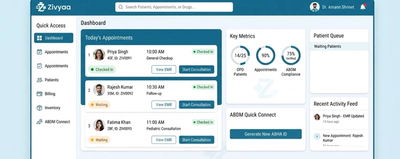
The handovers are the problem this is built around. Zivyaa is being built so that registration, the consultation, the pharmacy, the lab, the ward and the billing counter write into one patient record rather than six of their own — which is the same argument this article has been making, and the reason we are not leading with AI.
That includes the parts vendors prefer not to demonstrate: what happens when an OPD patient is admitted, whether a ward indent moves stock without a phone call, whether a discharge bill assembles itself. And it has to survive the conditions it will actually run in — a district town where the connection drops mid-OPD, and a front desk with no appetite for a second data-entry screen. Consent sits underneath all of it, because a record moving between providers without one is not a feature, it is a liability.
It is honest to call this work in progress rather than a solved problem. Nothing here has launched, and connecting departments that have run separately for years is slow work that nobody should claim is finished. If this is the layer your hospital is missing, you can see how we are approaching it, or book a walkthrough and ask every question from the list above.