By September 2026, India had created 97.45 crore ABHA accounts, according to the ABDM public dashboard. The government's count of people enrolled under Ayushman Bharat PM-JAY through Ayushman cards stood at over 42 crore in October 2025. Two cards, two very different numbers. And when people in India type a question about ABHA into Google, the one the search box offers again and again is some version of: is this the same as the Ayushman card?
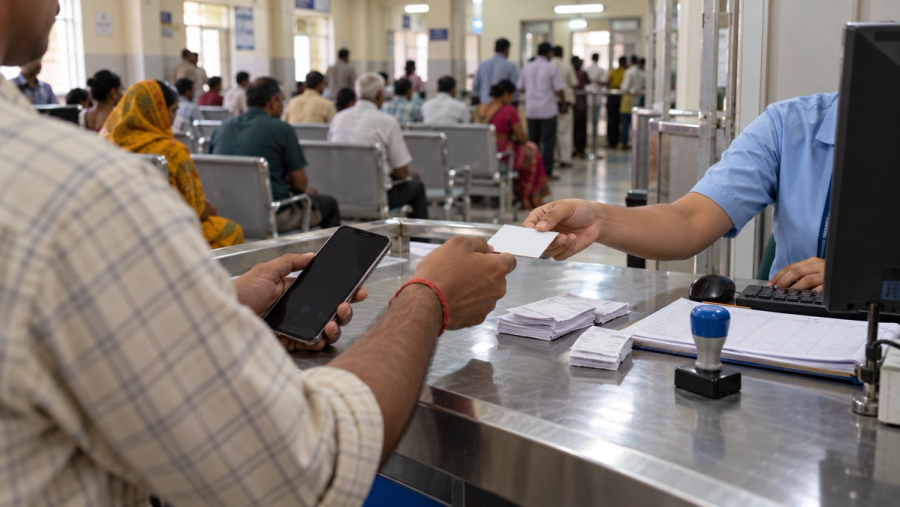
It is not, and the place the difference matters most is a hospital's registration counter. A patient who believes ABHA means free treatment arrives expecting a cashless admission nobody can give them. A patient with a genuine Ayushman card gets asked for "the Ayushman ID" by someone who means ABHA. Both conversations go wrong for one reason: the counter has no clean one-line answer.
Short answer: ABHA and the Ayushman card are not the same. ABHA is a free 14-digit digital health ID under ABDM that links a person's health records. The Ayushman card belongs to Ayushman Bharat PM-JAY, which gives eligible families cashless hospital treatment of up to ₹5 lakh a year. Having an ABHA does not make anyone eligible for PM-JAY.
What is an ABHA card?
An ABHA card is the printed or digital form of an ABHA number. ABHA, the Ayushman Bharat Health Account, is a unique 14-digit number that links a person's health records across providers under the Ayushman Bharat Digital Mission (ABDM), the government framework for exchanging health records with consent. A PIB explainer from April 2024 says any individual can create one free of cost, and a PIB update from February 2024 states plainly that creating an ABHA number is voluntary.
Alongside the number comes an ABHA address, an easy-to-remember username such as name@abdm, which the person uses to see and share records in an app. That app-side copy is what is called a personal health record, which is a different thing from the hospital's own EMR — we have explained the difference between EMR, EHR and PHR separately.
The records themselves stay with whichever hospital, lab or clinic created them. According to the same April 2024 explainer, ABDM links those places together and does not store medical records itself.
What ABHA does not carry is money. It is an identifier. It tells a hospital's system who this person is across providers and says nothing about who pays for their treatment.
What is an Ayushman card?
An Ayushman card is the beneficiary card of Ayushman Bharat Pradhan Mantri Jan Arogya Yojana (AB PM-JAY), the government's health cover scheme. According to a PIB backgrounder from November 2025, PM-JAY covers up to ₹5 lakh per eligible household per year for secondary and tertiary care and hospitalisation, cashless, at empanelled government and private hospitals.
The word doing the work there is eligible. PM-JAY is aimed at socio-economically deprived families, and the card is how a hospital knows this person is covered. Since September 2024 there has been one large exception. The Union Cabinet extended PM-JAY to every senior citizen aged 70 and above irrespective of income, with a separate card — the Ayushman Vay Vandana card — and, for seniors whose family is already covered, a top-up of up to ₹5 lakh a year for themselves alone.
Is the ABHA card the same as the Ayushman card?
No. The PIB explainer on ABHA answers this in its own myth-versus-reality section: getting an ABHA number does not mean enrolment in PM-JAY, and having one does not make a person eligible for any scheme. ABHA is only a number that links a person's health records.
The mix-up is easy to understand. Both carry the Ayushman Bharat name, both come out of government portals, and both end up as a card in the same wallet. But one is an identity and the other is a cover, and they answer different questions:
- Purpose — ABHA links a person's health records; the Ayushman card shows PM-JAY coverage.
- Who can get it — ABHA: any individual, free and voluntary; the Ayushman card: families eligible under PM-JAY, plus everyone aged 70 and above.
- Money — ABHA: none; the Ayushman card: cover of up to ₹5 lakh per eligible household per year.
- Where it counts — ABHA: providers whose systems connect to ABDM; the Ayushman card: hospitals empanelled under PM-JAY, public and private.
- What it replaces — neither replaces the other, and neither replaces the hospital's own registration.
Does an ABHA card give free treatment or insurance?
No. ABHA carries no insurance cover and no entitlement to free treatment. A patient who has only an ABHA pays, or claims through their own insurance, exactly as they would without one. Cashless treatment under the government scheme comes from PM-JAY, through the Ayushman card, and only for people who are eligible.
This is the most useful sentence a front desk can learn, because the wrong belief is expensive in a particular way. It rarely surfaces at registration. It surfaces at admission, or worse, at the billing counter on the day of discharge, when a family has already planned around money that was never there.
Can an Ayushman card be used in a private hospital?
Yes, if that private hospital is empanelled under PM-JAY — not at every private hospital. The PIB backgrounder of November 2025 counts over 33,000 empanelled hospitals, 15,380 of them private. A private hospital that is not empanelled cannot treat a patient under PM-JAY, however valid the card.
ABHA works differently, because there is nothing to claim. A hospital whose software connects to ABDM can use a patient's ABHA to identify them and, with consent, to link or receive records. Whether a given private hospital does that depends on whether it has done the integration, which is a separate question from empanelment.
So the patient's real question is specific to the building they are standing in. "Is this hospital empanelled under PM-JAY?" should get an instant yes or no at the counter. "Does this hospital use ABHA?" is a different question with its own answer.
Is an ABHA card mandatory?
No. A PIB update on ABDM from February 2024 states that creation of an ABHA number is voluntary. A patient without one is still a patient, and registration, treatment and billing do not depend on it.
Where a scheme or a facility asks for ABHA, the patient is entitled to ask what it will be used for. A good front desk answers that before being asked: it links your records so the next doctor can see them, if you agree.
What should a hospital front desk tell patients?
Two sentences cover most of it. ABHA is your health ID: it keeps your records linked, it is free, and it does not pay for treatment. The Ayushman card is PM-JAY coverage: it pays for eligible hospital treatment, cashless, at empanelled hospitals.
Beyond the script, four habits prevent most of the trouble:
- Ask which card the patient is holding before asking for "the Ayushman card". Both have the word on them.
- If the patient expects cashless treatment, confirm PM-JAY eligibility and this hospital's empanelment at registration, not at discharge.
- Do not make care wait on ABHA. Register the patient first; create or link ABHA when there is time and the patient agrees.
- Ask before linking records. Under ABDM, records are shared only after the patient's consent, and the consent can cover some records and not others.
None of this needs software. It needs the counter to know the difference, which costs nothing.
Where does hospital software come into this?
Hospital software matters here because the card question is really a registration question. The front desk captures two different facts about a patient — an identity, which is ABHA, and a payment route, which may be PM-JAY — and they lead to different work afterwards: one to records, the other to pre-authorisation and claims.
Software that stores them in one field, or asks for an "Ayushman ID" without saying which, rebuilds the counter's confusion inside the database. And an ABHA field on a registration form is not the same as ABDM integration; we have written about what ABDM integration should actually mean when choosing clinic software.
Where Zivyaa fits
The problem in this article is small, and it is the kind Zivyaa is being built to get right: a registration desk that records a patient's identity and their payment route as two separate facts from the first minute, so the ward, the pharmacy and the billing counter all see which one applies.
ABHA is part of that plan, and it is honest to say where it stands. Zivyaa has not launched, and nothing here is a claim that any ABDM or PM-JAY workflow is live or certified in it. The bet is simpler than a feature list: if the software never asks for the two cards as one thing, the counter stops confusing them too.
If that is the problem at your registration desk, see the pricing or book a walkthrough and ask us how we are approaching it.