By 1 October 2025, more than 86.51 lakh senior citizens aged 70 and above had been given an Ayushman Vay Vandana card, according to a PIB backgrounder. The card was rolled out on 29 October 2024. Nearly two years on, it is still an easy card to explain badly at a front desk — partly because it looks like the ordinary Ayushman card, and partly because it came with rules the ordinary card never had.
The confusion lands at registration. A 74-year-old's son asks whether his father's pension scheme rules it out. A family with a regular Ayushman card assumes grandfather is already covered on it. Someone believes a card means free OPD visits. Each of those has a clear answer, and each is worth getting right before the admission, not at the billing counter.
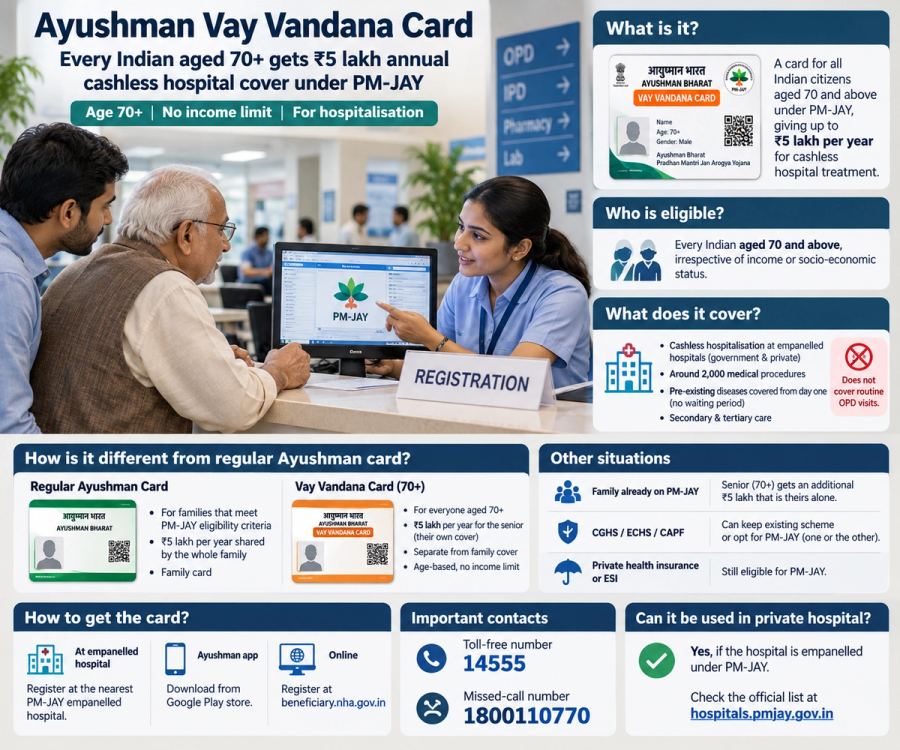
Short answer: the Ayushman Vay Vandana card gives every Indian aged 70 and above cashless hospital cover of up to ₹5 lakh a year under PM-JAY, whatever their income. Seniors in families already on PM-JAY get their own extra ₹5 lakh. It covers hospitalisation, not routine OPD, at empanelled hospitals, and seniors can enrol at the hospital, on the Ayushman app or online.
What is the Ayushman Vay Vandana card?
The Ayushman Vay Vandana card is the card issued to senior citizens aged 70 and above under Ayushman Bharat Pradhan Mantri Jan Arogya Yojana (PM-JAY), the government's scheme for cashless hospital treatment. The Union Cabinet approved the expansion on 11 September 2024, and a PIB release of that date says eligible seniors would be issued a new, distinct card. It was rolled out on 29 October 2024.
It is not ABHA. ABHA is a free health ID that links a person's records and carries no treatment cover at all — a confusion we have written about separately in why an ABHA card is not an Ayushman card. The Vay Vandana card is the opposite kind of thing: it is about who pays for a hospital stay.
Who is eligible for the Vay Vandana card?
Every Indian aged 70 and above is eligible, irrespective of income or socio-economic status, according to the PIB release of 11 September 2024. That is the part that changed things: the regular PM-JAY card is meant for families that meet the scheme's eligibility criteria, while the Vay Vandana card is based on age alone.
The same release sets out three situations front desks meet often:
- Families already covered under PM-JAY: the senior aged 70 and above gets an additional top-up cover of up to ₹5 lakh a year for themselves, which they do not share with younger family members.
- Seniors on CGHS, ECHS or Ayushman CAPF: they can either keep their existing scheme or opt for PM-JAY — one or the other.
- Seniors with private health insurance or ESI: they are still eligible for PM-JAY.
All other seniors aged 70 and above get cover of up to ₹5 lakh a year on a family basis, per the same release.
What does the Vay Vandana card cover?
The Vay Vandana card covers hospitalisation, not everyday OPD visits. PM-JAY provides cashless cover for secondary and tertiary care and hospitalisation at empanelled government and private hospitals, according to a PIB backgrounder of November 2025. A PIB release of December 2024 adds that the card covers around 2,000 medical procedures, and that pre-existing diseases are covered from the first day, with no waiting period.
That last point matters more for this age group than for any other. At 70, almost everyone has something — diabetes, a heart condition, a hip that has been troubling them for years. A scheme that covers pre-existing illness from day one is very different from a private policy with a waiting period, and families often do not know the difference until they are told.
How is the Vay Vandana card different from the regular Ayushman card?
The Vay Vandana card and the regular Ayushman card both belong to PM-JAY, and both pay for cashless hospital treatment at empanelled hospitals. What differs is who gets them and how the money is shared:
- Who qualifies: the regular card goes to families that meet PM-JAY's eligibility criteria; the Vay Vandana card goes to everyone aged 70 and above, whatever their income.
- Whose cover it is: on the regular card, ₹5 lakh a year is shared by the whole family; a senior in such a family gets an extra ₹5 lakh that is theirs alone.
- Which card to carry: the senior's own Vay Vandana card, not the family's regular card, is the one that shows their separate cover.
The practical upshot is simple. A family that already has an Ayushman card should still get the grandparent their own Vay Vandana card, because the top-up is theirs and does not eat into what the rest of the family can use.
What if the senior already has private health insurance?
A senior with private health insurance or ESI is still eligible for PM-JAY, according to the PIB release of September 2024. Having a private policy does not rule anyone out. How the two are used together for a particular admission is a question for the hospital's insurance desk and the insurer, and it is worth asking before admission rather than after.
How do senior citizens get the Vay Vandana card?
Seniors can enrol in three ways, according to PIB's December 2024 release:
- At the nearest empanelled hospital, which can register them.
- Through the Ayushman app, downloaded from the Google Play store.
- Online, at beneficiary.nha.gov.in.
For help, the same release gives the toll-free number 14555, and a missed-call number, 1800110770. In practice it helps to keep the senior's Aadhaar card and the mobile number linked to it at hand before starting, whichever route is used.
Can the Vay Vandana card be used in a private hospital?
Yes, if the private hospital is empanelled under PM-JAY. PIB's November 2025 backgrounder counts over 33,000 empanelled hospitals, 15,380 of them private. A private hospital that is not empanelled cannot treat a patient under PM-JAY, however valid the card, so the first question at any counter is whether this hospital is on the list.
Where is the Vay Vandana hospital list?
The official list of PM-JAY empanelled hospitals, government and private, is at hospitals.pmjay.gov.in. Check it before the admission rather than at the desk, and if the hospital you want is not on it, the card cannot be used there.
What should a hospital front desk tell senior patients?
Most of the confusion at the counter goes away with five checks, done at registration rather than at discharge:
- Ask the patient's age first. At 70 or above, PM-JAY cover is available whatever the family's income.
- Ask which card they are holding. A regular Ayushman card, a Vay Vandana card and an ABHA card are three different things.
- If the family is already on PM-JAY, explain that the senior's cover is a separate top-up for them alone, not shared with the family.
- If the patient is a CGHS, ECHS or CAPF beneficiary, explain that they use one scheme or the other, and let them choose.
- Be clear that the card covers hospitalisation at empanelled hospitals — not routine OPD consultations.
If the senior has no card yet and the hospital is empanelled, registration can often be started right there. That is worth offering. A family that walks in confused and walks out enrolled remembers which hospital helped.
Why does this matter for hospitals in Uttar Pradesh?
For PM-JAY hospitals in Uttar Pradesh, getting eligibility right at the front desk is now part of a stricter regime. UP's HEM 2.0 standards for empanelled hospitals include HFR registration, according to May 2026 reports quoting the state agency that runs the scheme, and we have written about what UP hospitals have to do under ABDM and HEM 2.0.
Where Zivyaa fits
The mistakes in this article are registration mistakes: the wrong card noted, a scheme not asked about, an eligibility question left for the billing counter. Zivyaa is being built so that the registration desk records a patient's payment route clearly from the first minute, and the ward and billing counter see the same thing.
PM-JAY and ABDM integration are part of that plan — they are not live and not certified, and nothing has launched yet. If the front desk is where your hospital loses time, see the pricing or book a walkthrough.