
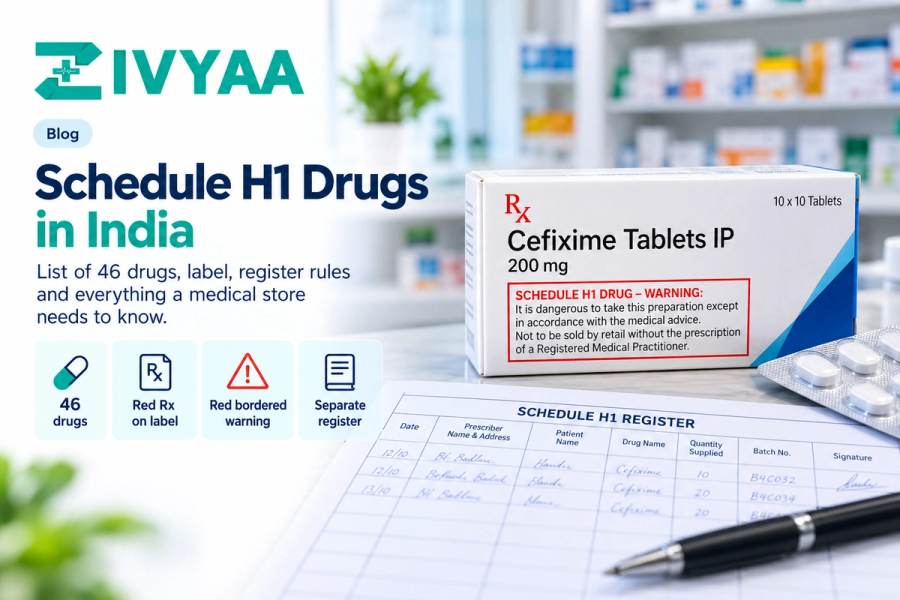
Pick up a strip of cefixime at any Indian medical store and look at the top-left corner of the label. There is an Rx printed in red. Somewhere on the pack there is also a box with a red border that begins "Schedule H1 Drug – Warning". That label is the visible half of a rule. The other half is a register, and the rule is unusually specific about when it gets filled in.
Short answer: Schedule H1 is a list of 46 drugs — newer antibiotics, certain habit-forming drugs and anti-TB drugs — added to the Drugs and Cosmetics Rules, 1945 by notification G.S.R. 588(E) of 30 August 2013. They are sold only on prescription, carry a red Rx and a red-bordered warning on the label, and every sale goes into a separate register with the prescriber's name and address, the patient's name, the drug and the quantity, kept for three years.
What is Schedule H1?
Schedule H1 is a separate schedule of the Drugs and Cosmetics Rules, 1945, created by the Drugs and Cosmetics (Fourth Amendment) Rules, 2013 and notified as G.S.R. 588(E) on 30 August 2013. The notification itself says the rules came into force six months after publication. According to a CDSCO advisory of February 2017, Schedule H1 was introduced for stricter control over carbapenems, third- and fourth-generation antibiotics, certain habit-forming drugs and anti-TB drugs, as part of the effort to limit antimicrobial resistance.
The same notification also removed a set of these drugs from Schedule H. So H1 is not an extra tier stacked on top of Schedule H. It is its own schedule, with its own register and its own label, and a drug on the H1 list is handled by the H1 rules.
Which drugs are in the Schedule H1 list?
These are the 46 drug substances in the Schedule H1 list as notified in G.S.R. 588(E), in the notification's own order:
- Alprazolam
- Balofloxacin
- Buprenorphine
- Capreomycin
- Cefdinir
- Cefditoren
- Cefepime
- Cefetamet
- Cefixime
- Cefoperazone
- Cefotaxime
- Cefpirome
- Cefpodoxime
- Ceftazidime
- Ceftibuten
- Ceftizoxime
- Ceftriaxone
- Chlordiazepoxide
- Clofazimine
- Codeine
- Cycloserine
- Diazepam
- Diphenoxylate
- Doripenem
- Ertapenem
- Ethambutol Hydrochloride
- Ethionamide
- Faropenem
- Gemifloxacin
- Imipenem
- Isoniazid
- Levofloxacin
- Meropenem
- Midazolam
- Moxifloxacin
- Nitrazepam
- Pentazocine
- Prulifloxacin
- Pyrazinamide
- Rifabutin
- Rifampicin
- Sodium Para-aminosalicylate
- Sparfloxacin
- Thiacetazone
- Tramadol
- Zolpidem
The note printed under the list matters at the counter. Preparations containing these substances and their salts are covered too, except those meant for topical or external use. Eye, ear and nose preparations are the exception to that exception — they stay covered. So a moxifloxacin eye drop belongs in the register, while a preparation meant only for the skin does not.
This is the list as notified in 2013. Schedules can be amended by later notifications, so check the current text on the CDSCO website before treating any printed list as final, this one included.
How do you identify a Schedule H1 drug on the pack?
By its label. Rule 97 of the Drugs and Cosmetics Rules, as amended by the same 2013 notification, requires a Schedule H1 formulation to carry the symbol Rx in red, conspicuously displayed on the left top corner of the label, and a warning inside a box with a red border:
Schedule H1 Drug – Warning: It is dangerous to take this preparation except in accordance with the medical advice. Not to be sold by retail without the prescription of a Registered Medical Practitioner.
The red-bordered box is the quickest check at the counter. A strip that carries it needs a prescription and a register entry; a strip that does not is handled under whichever schedule it does belong to.
What must the Schedule H1 register contain?
Five things, written at the time of the sale. Rule 65(3) of the Drugs and Cosmetics Rules, as amended in 2013, says the supply of a Schedule H1 drug shall be recorded in a separate register at the time of the supply, giving:
- the name of the prescriber
- the address of the prescriber
- the name of the patient
- the name of the drug
- the quantity supplied
The records must be kept for three years and be open for inspection. Three phrases in that sentence do most of the work. A separate register means not the sales book. At the time of the supply means at the counter, not at closing time. Open for inspection means the register has to be producible when a drug inspector asks for it.
Our free Schedule H1 register template has those five columns marked, plus date, batch number and the pharmacist's signature, with English and Hindi headings — as a print-ready PDF or a file for Excel.
What is the difference between Schedule H and Schedule H1?
Both are prescription-only; Schedule H1 adds a register and a stronger label. The 2013 notification is explicit on three points:
- Register: every Schedule H1 sale goes into its own separate register, with the five details above, kept for three years.
- Label: a Schedule H1 drug carries the Rx in red on the left top corner and the warning in a red-bordered box.
- List: Schedule H1 is short and specific — 46 substances — and the drugs moved into it were taken out of Schedule H.
The reason for the split is the reason behind the whole schedule. Antibiotics sold without a prescription are one of the routes by which resistance spreads, and a register with the prescriber's name in it is a record of who authorised each sale.
Can the Schedule H1 register be kept on a computer?
The rule does not say paper. It asks for a separate register with those details, kept for three years and open for inspection. Whether a digital register satisfies your state's drug inspector is a question to put to your licensing authority before you give up the bound book, and the answer is worth having in writing.
What should a medical store do this week?
- Print the current Schedule H1 list from the CDSCO website and keep it at the counter.
- Start a separate H1 register if your H1 sales are going into the sales book.
- Make the entry at the counter, from the prescription, with the prescriber's name and address.
- Remember that eye, ear and nose preparations of these drugs are covered.
- Keep every filled register for three years from the last entry in it.
Where Zivyaa fits
The weak point in this rule is the gap between the sale and the register. Zivyaa's pharmacy software is being built so that when a Schedule H1 drug is billed, the counter is asked for the prescriber and the patient, and the register entry is made with the sale rather than copied into a book later.
Nothing has launched yet, and whether a digital register satisfies your drug inspector is still a question for your licensing authority. If you run a medical store and want to see how we are approaching it, see the pricing or book a walkthrough.