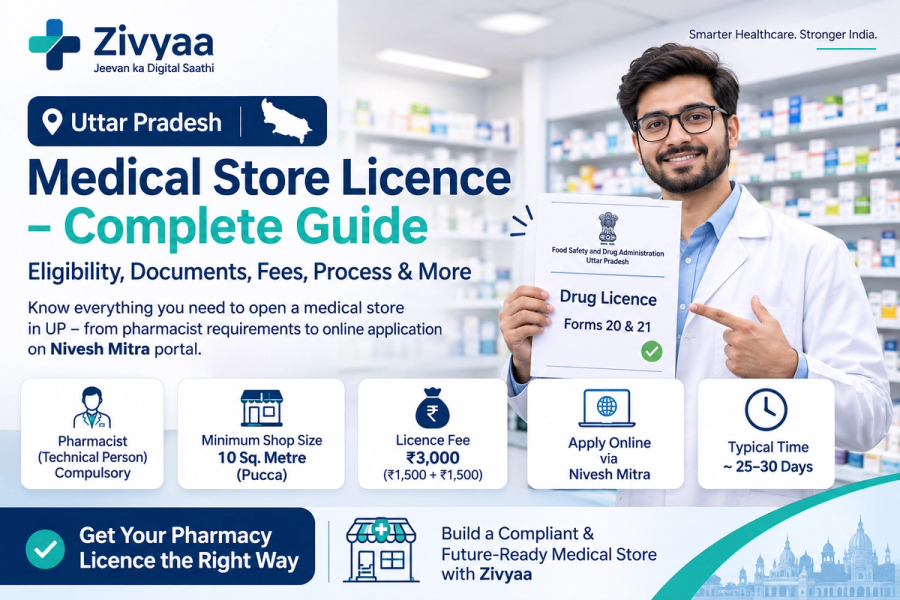
The fee for a retail drug licence in Uttar Pradesh is ₹3,000. That is the cheap part. What actually decides whether a medical store opens is a registered pharmacist willing to put their name on the licence, at least ten square metres of pucca floor, and a cold store for the medicines that need one — all checked in person by a Drug Inspector before the licence is issued.
Short answer: to open a medical store in UP you need a retail drug sale licence on Forms 20 and 21, applied for on Form 19 through the Nivesh Mitra portal. The Food Safety and Drug Administration (FSDA) requires a pharmacist as the technical person, a pucca shop of at least 10 square metres with proper and cold storage, ownership or rent papers with a map of the shop, and a fee of ₹3,000. A Drug Inspector verifies the shop before the licence is approved and issued online.
Which licence does a medical store need?
A retail drug sale licence, issued on two forms at once. FSDA UP's licence table lists the application as Form 19 and the retail licence as Forms 20 and 21. Form 20 covers ordinary drugs; Form 21 covers drugs in Schedules C and C1, the category that includes products such as insulin and vaccines. That is why the fee is quoted as ₹1,500 + ₹1,500: one for each form.
The same table lists the other sale licences, so it is worth knowing which one you are not applying for:
- Wholesale licence: Forms 20B and 21B, applied for on Form 19.
- Restricted licence: Forms 20A and 21A, applied for on Form 19A.
- Schedule X drugs: Form 20F for retail and Form 20G for wholesale, applied for on Form 19C.
Is a pharmacist compulsory for a medical store?
Yes, for a retail licence. FSDA UP's list of requirements says the technical person must be a pharmacist for a retail licence, and a pharmacist or competent person for a wholesale one. The pharmacist is not just a name on a form: they register separately on the FSDA portal as a technical person, a Drug Inspector verifies and approves that profile, and the firm then maps the pharmacist to its own application.
This is the step that most often decides the timeline. If you are not a pharmacist yourself, find the pharmacist first, and make sure their education certificates are ready, because FSDA asks for them.
How big must the shop be?
At least 10 square metres for a retail or a wholesale licence, and 15 square metres if you apply for both, according to FSDA UP's requirements. The shop must be of pucca construction and kept hygienic, with good storage and cold storage. Rule 64 of the Drugs and Cosmetics Rules, 1945 sets the same principle nationally: a licence is granted only if the licensing authority is satisfied that the premises are adequate, have proper storage for preserving the drugs, and are in the charge of a competent person.
What documents are needed for a medical store licence?
FSDA UP lists these for a sale licence. For a single owner running one retail shop, the ones that apply are:
- A current photograph of the applicant.
- Address and ID proof.
- Education certificates of the technical person (the pharmacist).
- Proof of ownership of the building — or, if rented, the rent proof or the owner's NOC.
- A map of the premises.
- Work details of the last three years.
A partnership firm adds its partnership deed; a company or LLP adds its certificate of incorporation and memorandum and articles; an HUF, a trust or a society adds its own deed or registration; an attorney adds the power of attorney.
What is the fee for a medical store licence in UP?
₹3,000 for a retail licence. FSDA UP's fee schedule lists:
- Retail licence (Forms 20 and 21): ₹3,000 (₹1,500 + ₹1,500).
- Wholesale licence (Forms 20B and 21B): ₹3,000 (₹1,500 + ₹1,500).
- Restricted licence (Forms 20A and 21A): ₹1,000 (₹500 + ₹500).
- Schedule X retail (Form 20F) or wholesale (Form 20G): ₹500 each.
The same schedule lists a late fee of 2% per month, for up to six months. The fee is paid online through Nivesh Mitra.
How do you apply for a drug licence online in UP?
Through Nivesh Mitra, the state's single-window portal, which hands you over to the FSDA portal. FSDA UP's own "How to Apply" sheet gives these steps:
- Register on the Nivesh Mitra portal with an email ID and mobile number.
- Log in with the ID and password sent to your email after registration.
- Verify the email and complete the common application form on Nivesh Mitra.
- Create a unit ID and apply for the licence — you are taken to the FSDA portal.
- Complete the profile there and apply on the correct licence form.
- Pay the licence fee through Nivesh Mitra.
- The application is submitted to the department's portal.
Separately, the pharmacist registers on fsdaup.gov.in under "Registration of Technical Person", completes their profile, and waits for the Drug Inspector to verify it. Then the firm logs in, opens "Technical Person mapping" and adds the pharmacist.
How long does it take to get the licence?
FSDA UP's own process chart sets a time for each stage. If the application has discrepancies, it goes back to the applicant for modification, with 7 days to fix it. The application then goes to the Drug Inspector for verification, with 10 days set for that. If the inspection report is satisfactory, the Drug Licensing Authority approves the licence, with 15 days set for approval, and the applicant downloads a digitally signed licence. An application whose discrepancies are not removed is rejected.
Those are the department's targets for each stage, not a promise of the total. In practice the clock starts only when every document is in and the pharmacist's profile is approved, which is why those two are worth finishing first.
Does a drug licence need renewal?
Not in the old sense. Under Rule 63 of the Drugs and Cosmetics Rules as it now stands, a sale licence stays valid as long as a retention fee is paid every five years, and FSDA UP's fee schedule lists the same ₹3,000 against both the licence and its retention. Note the due date on your own licence; the late fee runs from there.
What has to be in place on the first day?
The licence is the start of the paperwork, not the end. Two registers matter from the first sale. Every Schedule H1 drug sold goes into a separate register, at the time of sale, for three years — our free Schedule H1 register format has the columns the rule requires. And a store that tracks near-expiry stock from day one returns it to the distributor in time instead of writing it off; our near-expiry register format is a simple way to start.
Where Zivyaa fits
A new medical store spends its first months on billing, batches, expiry dates and registers, usually in three different places. Zivyaa's pharmacy software is being built to keep those on one record: the bill, the batch it came from, the expiry date, and the Schedule H1 entry made with the sale.
Nothing has launched yet. If you are opening a store in Uttar Pradesh and want to see how we are approaching it, see the pricing or book a walkthrough.