
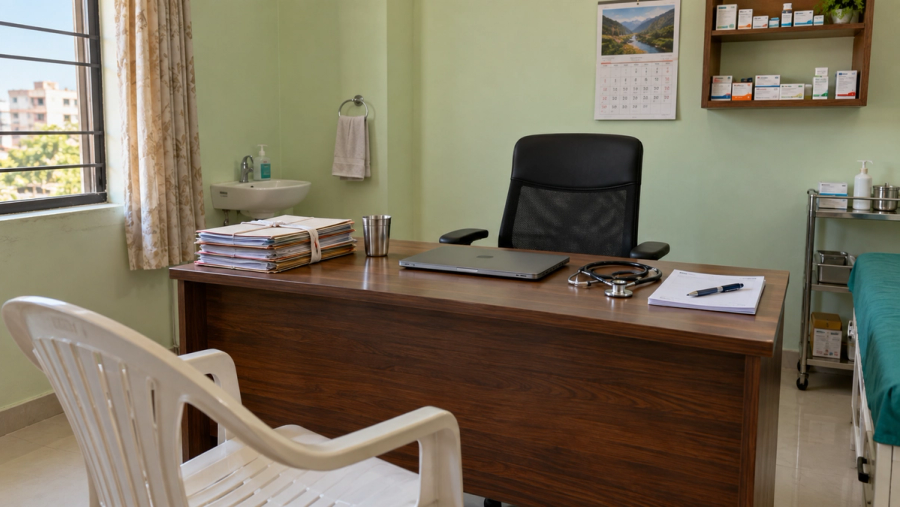
It is eleven in the morning at a single-doctor clinic and there are fourteen people in the waiting area. The receptionist is writing names into a register, the doctor is handwriting a prescription, and a patient who came in March is trying to remember the name of the tablet that gave her a rash. Nobody in the room is short of skill. They are short of the last visit.
That is the job clinic management software is for, and it is a narrower job than most product pages suggest. A clinic does not need a hospital system. It needs the previous visit on the screen, a prescription out of the door quickly, the bill right, and the next appointment remembered — without the software becoming a second job for the person at the front desk.
Short answer: the right clinic management software for an Indian doctor is the one that is faster than paper at the desk, keeps every past visit one click away, handles billing and follow-up reminders, and lets you take your data with you if you leave. ABDM integration is worth having, but check exactly what a vendor means by it.
What is clinic management software?
Clinic management software is the system a clinic or small practice uses to run a patient visit end to end: registration or appointment, the consultation record, the prescription, the bill and the follow-up. Its clinical part is an EMR, an electronic medical record — the digital version of the patient's file. The rest is the small amount of administration a clinic has.
It is not a hospital management system. A clinic has no wards, no store and usually no in-house lab, so a product built for a hundred-bed hospital brings modules that sit empty and still need setting up. We have written separately about how EMR, EHR and HMS differ, which is worth reading before a demo because vendors use the three words loosely.
Do small clinics actually need software?
Not every clinic does, and it is worth saying so. A doctor who sees a small, steady list of patients and keeps good paper records is not losing much. The case gets stronger as three things grow: the number of returning patients whose history matters, the number of people who touch a visit — a receptionist, an assistant, a second doctor — and the amount of money moving through the counter.
The honest reason to switch is rarely "going paperless". It is the returning patient. A paper file that cannot be found in the time a consultation takes is, for that consultation, a file that does not exist.
Which features matter most in clinic software?
Four features matter far more than the rest, and they are the ones a demo tends to rush past.
- Speed at the desk. A returning patient should be found in seconds, by phone number, not re-entered through a form. If the front desk is slower than the register, the register comes back.
- The previous visit, visible. Past complaints, diagnoses, prescriptions and reports on the same screen as today's consultation, without clicking through tabs.
- Prescriptions the doctor will actually use. Templates for common cases, a medicine list that knows Indian brand names, and output that prints cleanly or reaches the patient's phone.
- Billing and follow-ups. Consultation and procedure charges, receipts, and a reminder that goes out before the follow-up date instead of a list someone has to remember to check.
Everything else — telemedicine, patient apps, analytics dashboards — is worth paying for only once those four work. A clinic that buys the extras first tends to end up paying for features while the receptionist keeps a notebook.
What does ABDM integration mean for a clinic?
ABDM, the Ayushman Bharat Digital Mission, is the government framework that lets health records move between providers with a patient's consent. It is not software a clinic installs. Its building blocks are ABHA, the individual's unique digital health identifier; registries of health facilities and health professionals; and a consent-based way of exchanging records.
The records themselves do not go to a central government database. A PIB explainer from April 2024 describes ABDM as a federated architecture, in which health records continue to be stored where they are created — at your clinic, in your software — and ABDM links those places together. A PIB release from August 2025 adds that health data is exchanged only after the patient's consent.
For a clinic, that turns "ABDM integration" into a question about specific abilities. Can the software verify or create a patient's ABHA at registration? Can it link today's visit to that ABHA so the patient can see it? Can it respond when another provider asks for a record with the patient's consent? An ABHA number field on the registration form is none of those. It is a text box.
So when a vendor says "ABDM compliant", ask which of those things work today, and ask to be shown rather than told. A precise answer is a good sign. "Yes, fully compliant" with nothing behind it is not.
Is ABDM mandatory for private clinics?
There is no single answer that holds for every clinic, and anyone who gives you one on a sales call should be asked for the circular. Requirements depend on your situation and have changed over time, so check the current National Health Authority guidance for your own case rather than a vendor's summary of it — including this one.
What is clear is the direction: more of Indian healthcare is being connected through ABDM, not less. Choosing software that can do the specific things above keeps that option open without making it the reason you buy.
What should you ask before buying clinic software?
- Find a returning patient in front of me, by phone number. How long did that take?
- Show me last visit's prescription while I write today's.
- Which ABDM functions work today — ABHA verification, linking records, sharing with consent? Show me one.
- What happens when the internet drops in the middle of OPD?
- How do I get all my patient data out if I leave, and in what format?
- What will I pay in year two, not just year one — per doctor, per branch, per SMS or WhatsApp message?
- Who picks up the phone when the billing screen stops working on a Monday morning?
The last two are easy to skip in a demo, and they are the two a clinic cannot fix once the software is installed.
Where Zivyaa fits
The clinic this article started with does not need more software. It needs the last visit in front of the doctor and a front desk that is faster than the register. That is what Zivyaa's clinic product is being built around: one record per patient that registration, the consultation, the prescription and the bill all write into, designed so work continues when the connection does not.
ABDM is part of that plan, and it is honest to say where it stands. Zivyaa has not launched, and nothing here is a claim that any ABDM function is live or certified. When it is, "which ABDM functions work today" is the question we would expect you to ask us too.
If that is the kind of clinic software you are looking for, see the published pricing or book a walkthrough and put the questions above to us.